
Edges
Natasha Khan
Show me your secrets
I know you are waiting to reveal yourself.
Hidden along the edges, creases, hollows, folds, and groves –
blending with the colours around you.
Whispering, come find me
Living the Story
Nita Shori
A migraine of the head-pounding, eye-aching, nauseating variety made Nita turn off the computer screen, plunging the damned manuscript into darkness. She would never make the deadline for submission. The headache was bad, but the scarier problem was what it implied. The life Nita had created for Lily — the main character in her writing — was overtaking Nita’s existence. This life of missing deadlines, of massive migraines was all Lily’s, not Nita’s, and now Nita was living a life borrowed from fiction.
Raiding the medicine closet, she searched frantically for some Advil. Since Lily was stranded at a cottage, of course, Nita couldn’t find any. This was madness. Nita felt a looming presence closing in on her soul.
Wrapping a black and white polka-dotted scarf loosely around her shoulders –- wait, how did this exact scarf materialize from her screen into her life? —- she rushed out the door and lurched to a stop. Moving was excruciating. She cradled her head in her hands and sank down on the steps of her porch. Oh Lily, how do you do it?
After what seemed like an eternity, Nita stirred her head. Twilight had fallen and made the world a bit easier on her eyes. She shifted on her perch and felt something rustling beneath her. Jabbing her fingers underneath her kurta, she pulled out an envelope. It was addressed to Lily. The unmistakable curves stared back at Nita. It was her mother’s writing! Her mother’s ashes had been floating in the Ganga for the past thirty years, so either this letter was over thirty years old or… technically there was no ‘or’, but perhaps she should not rule out the possibility of someone forging her mom’s handwriting to get to her. But why was it addressed to Lily? Did it contain some answers to Lily’s search for her past? Nita pushed the thought away, shaking her head at the ridiculous merging of the real and unreal.
She tore open the envelope and found a tiny blue square of paper. “It’s in the nightstand.”
What was in the nightstand?
A rare heirloom? A handbook of answers? Advil would be nice, actually!
Nita sludged back inside, moving like a sloth for fear of agitating the nerves in her throbbing head. The nightstand was empty. She waved a desperate hand inside it, as if something would materialize into it. Her fingers scraped at and unpeeled a sticky note stuck to the back. The invention of the sticky note was really a milestone.
“No answers are worth as much as the questions. PS: Sorry, no Advil.”
Nita’s eyes got wider as her brain got foggier. She had a foreboding of waking up in The Squid Game, but written by George Orwell. She wanted answers. Or maybe she needed questions. She let out a scream that came out as a low moan, the sound reverberating through her dizzy head, making every cell of her body screech.
She dropped to the floor, her mind’s entrapment taking her for oscillating rides as she rested her head on the springy mattress. As she drifted, a sticky note bobbed up and down on the waves surrounding a cottage.
*
Five days later, Nita’s agent gave her a call, super-pleased at the novel she had churned out, right on the deadline. “Lily’s story of trauma, fear and pain will blow the minds of the readers. I know it’s not autobiographical, but it’s almost like you’ve lived it,” she laughed.
Joy
Rana Khan
“Could we speak about joy for once?” This opening line from a poem by Natasha Ramoutar, which was given to us as a prompt by our facilitator, resonated strongly with me. Indeed, we need to talk about joy more often than we do. Is there anything more joyous than a lovely sunny day and a clear blue sky? Or the beauty of birdsong, at dawn and dusk? The unexpected sight of daisies as I turn a corner, flowering trees in the summer, full of colour and fragrance– these are some of the memories I carry within me that give me joy on recollection.
Watching the seasons change has always been a thing of marvel. Somehow, the rotation of the earth seems personal to me, bringing with it heat, cold, rain, sunshine, and the changes emphasize a continuity that is both life-giving and life-changing. The days are just long enough for me to be pleasantly tired at the end, and the nights are restful. The earth seems mindful to me, giving us nurture along with caution. There are lessons in it to be learnt if we have the grace to understand them.
Life’s seasons have beauty and grace too. As I head towards eventual exit from this planet, I find that I have enjoyed my time so far, and cherish the memories that childhood, youth, and adulthood have bestowed on me. Last year, I joined a writing circle of fellow South Asian writers. I wanted to hone my craft and get feedback from peers. I did get that, but I also ended up discovering a community. A community that has nourished me and has been full of solidarity and shared hopes. There has been laughter, discovery of mutual interests, and wonder and delight at the magic of words. Poetry and prose, hopes and dreams – all this has been at the table, and more. I have also discovered friendship, and as I look ahead at building new relationships, I’m filled with a quiet excitement. Getting to know another human being, discussing our vulnerabilities and dreams, really communicating is also a reason to rejoice. Owning our stories is another reason, along with many others.
Yes, there is much on this earth for us to cherish. I’m in complete agreement with the poet – let’s speak about joy and be thankful for our blessings.
Greener on the other Life
Zahra Babrawala
I want to go to this land
Have you heard of it?
Mon amour
The people speak in the blossoming yellows
that daisies are made of
Mon amour
The wind flows across your cheek
soft as the touch of dusty pink twilight
Mon amour
Your heart beats so full
your body two ends of the rainbow
Mon amour
You can float through, laying on
Velvet green under shades of billowing branches
Mon amour
But the price is as dark as depths ocean deep
Are you willing to paint this world in black?
Community Care
Diwali Luharia
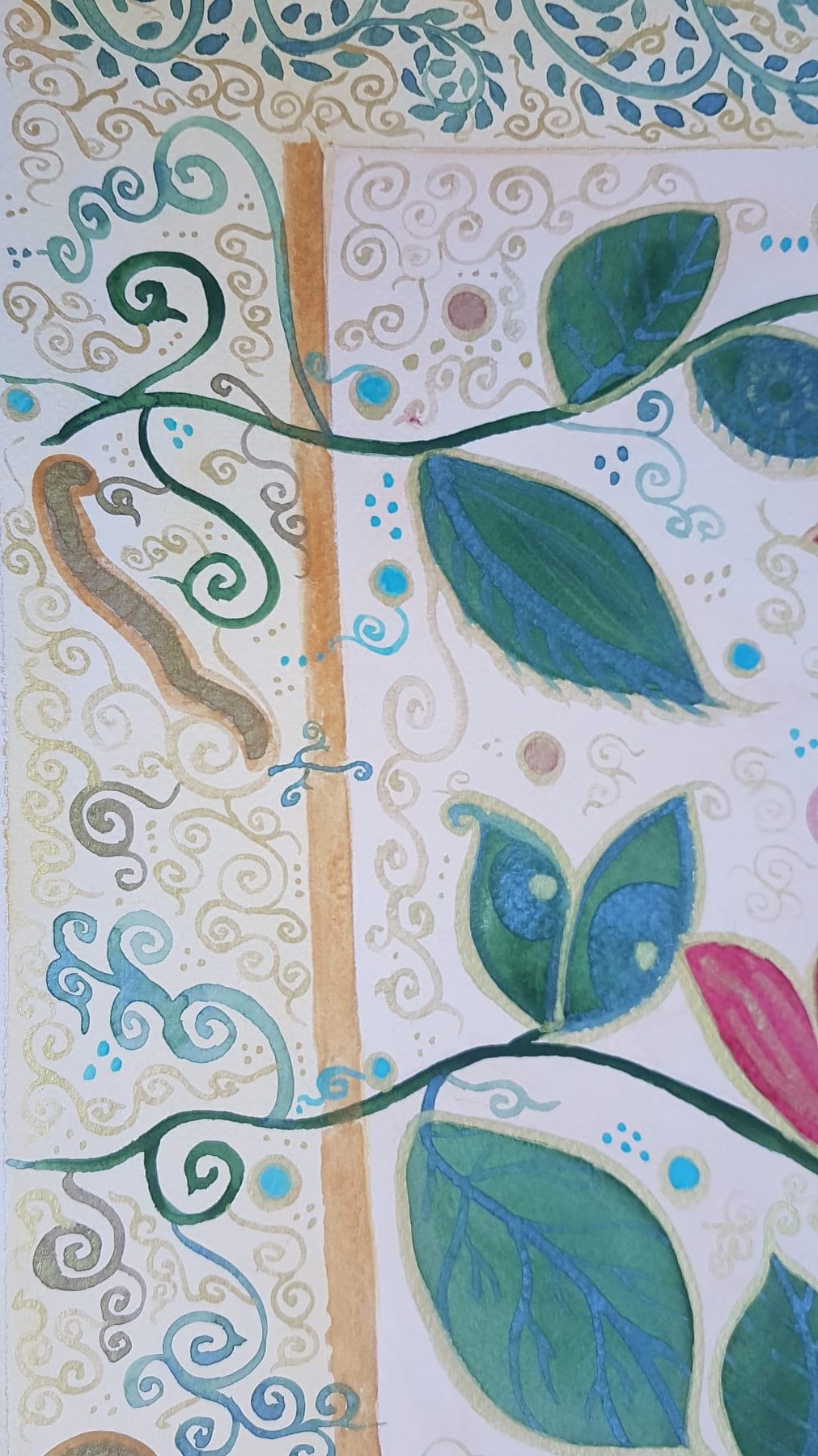
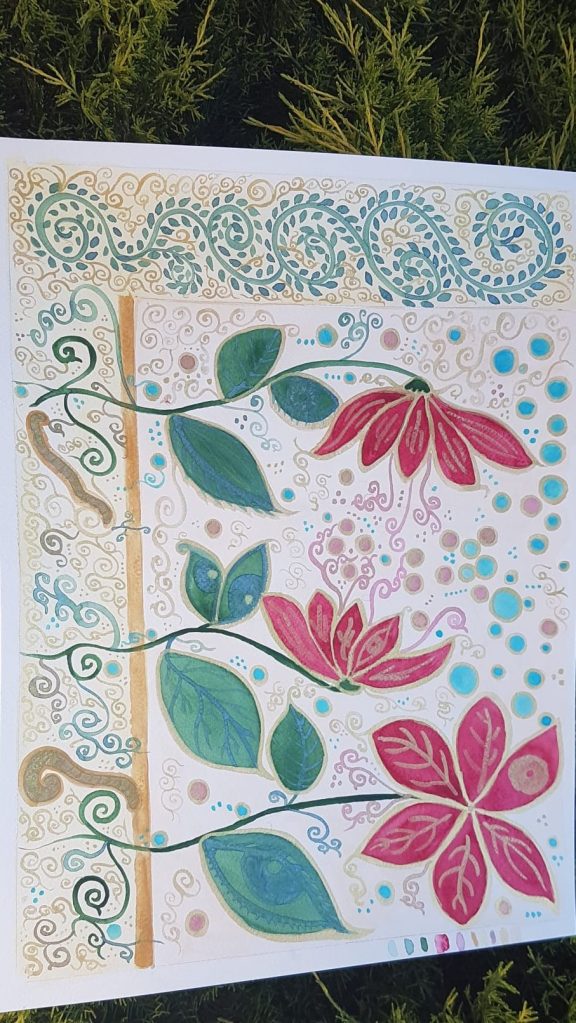
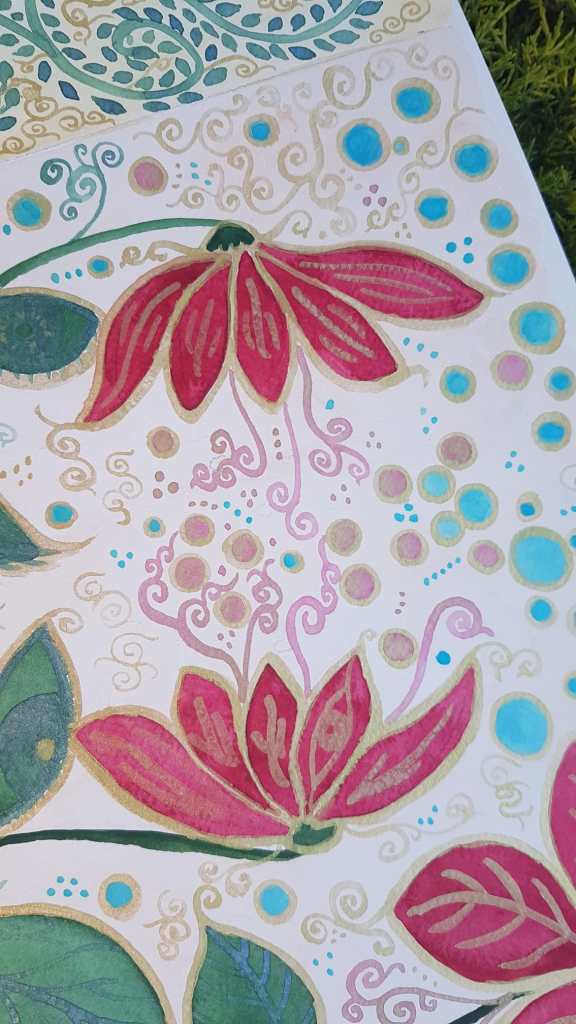
Supremo
Neetha Raman
It was a fine spring day. High up on an old oak tree, the Sparrow family chittered, arguing about who should be invited for lunch. Should we call the newly arrived Robins? What about the Warblers? Maybe not, too noisy and they tend to dominate the conversation with their insane singing. Hmm, perhaps the Swallows? Or is it too early for them to party?
The arguments continued while below Alice was engaged in a meaningful conversation with Coco, the little Shih Tzu that had adopted her three months ago. Coco looked up at her with her huge, brown, dinner-plate eyes as Alice tried to explain the game of Fetch. Coco wondered why Alice was so keen about the stick. Why would she keep throwing it away if she wanted it so badly? She grumbled softly, conveying to Alice that she would absolutely not want to waste a beautiful spring morning retrieving a smelly stick. She would rather curl up under this tree and snack on treats.
Alice was unmoved. She threw the stick and gave Coco a firm look. Coco sighed deeply and muttered, “Just this once, Alice. And it comes with a price tag of several treats.” Coco trotted off in the direction of the stick, which had landed right next to the sprawling vegetable patch.
The veggie patch was humming with activity. Coco stopped in her tracks when she heard the hubbub. Alice, following her, heard it too and decided to investigate. She picked up Coco and crept behind a nearby tree to eavesdrop.
Ms. Cauliflower was standing up, tall and proud, declaring that she was the queen of the kingdom as her beauty was unparalleled. “See the lovely florets on my head, framed by my beautiful green leaves; and my strong, healthy stalks that keep my head firmly on my shoulders. I am a natural leader!”
Mr. Broccoli intervened. “Hey Cauli, have you forgotten my superpowers? My lovely green skin gives humans plenty of protection against diseases! You, on the other hand, are just a pretty face and taste. My superpowers surely deserve the crown.”
Suddenly, a bright green head emerged, followed by a slim, eye-popping orange body. Mr. Carrots drawled, “Hey guys, quit fighting. I am the winner hands down, with my fantastic looks and my power to fight cancers! And versatile too – I am the staple for the entire human cycle – from toothless babies to toothless old people and everyone in between!”
A plump, muddy and tousled Ms. Beet popped up, trying to edge Carrots away. “Not so fast, my tall friend! Don’t forget that my rich red flesh gives stamina, endurance and power to humans! I hereby declare myself queen!”
“Ahem” – a subtle clearing of the throat made everyone turn and look. Mr. Eggplant walked regally down the patch. He turned and strutted his stuff before speaking. “Step aside Beets, and no offence, but your flesh and bloody juice appeal more to vampires than humans. I am the true king – my purple color signals royalty and my sleek, plump flesh is to die for!”
The entire patch cackled hysterically and pointed at Mr. Eggplant. “Hey Eggy, stop having delusions of grandeur; you are nothing but a slutty, dirty emoji for humans. We have cancelled you!”
A clump of soil stirred. Two oval heads popped up and yawned sleepily. “Are you vassals done with arguing? Make way for King Spud and Queen Spudsie. We are the true rulers of this world. Our shining golden jackets, our perfect shape, our tasty, creamy flesh, and the fact that civilization as we know it will surely come to an end if there are no fries—that, my subjects, is the true measure of supremacy. I command you to pay homage to the missus and me.”
Before the patch could protest at this audacity, a pair of boots that was attached to a large woman swathed in an apron and a hair net came into view. Everyone shrank back.
With a sharp glint in her eye, Cook reached down and yanked Spud and Spudsie. Dropping them into her basket, she smiled. “Perfect for the master’s lunch of fried chicken and baked potatoes.”
The whole patch let out a loud sigh of relief.
Mr. Broccoli sniggered. “Kings and queens, we may not be, but at least we live to see another day!”
Shaded Faces
Raj Bharaj
It started with my great grandmother
Or maybe even before that
I only know stories from my mother’s tongue
about the Ghunghat
Stories from her homeland Punjab
she tells me of her sisters, grandmother &
other women around her
She tells me that her grandmother, Sant Kaur
never showed her face to a man
kept her head down, eyes to the floor
never ever to gaze at her husband
She hid her face behind a veil
shadowed by her dupattas & sari pallu
& glanced at the patriarch from a layer of fabric
Rose coloured dupatta matching her hand stitched salwar kameez
bodies invisible
faces hidden
voices unheard
presence unnoticed
Soon entire bodies forgotten
& their names began to fade
The forgotten body was buried under
layers of fabric
tons of secrets
silenced tears
shadows of men
I asked, what was it all for?
Covered head, face
eyes, cleavage
& skin
Mom says it was to show respect to men
But I believe it was to keep us from being remembered.
You who are light
Paige Pinto
1.
This time, this time.
I awaken in a museum bathroom, cold, weary, shock of light. Sheen of sweat on my nose and forehead. Halo of frizz around my scalp that hasn’t been there since I was twenty-three. But this is then, and in this time I am twenty-three again, and you swish the door open a crack and call me, “K, hurry up.”
I feel like I am born into a strange universe, and my fingers are not my own until you whirl in and grab them, still dripping, and sweep me into the gallery of still things. Everything frozen but you.
Arizona is like this in August, a ricochet between hot and cold; a wall of heat so thick you can slice it, a shiver of air conditioning ripping through you. Between the intimacy of best friendship and something else, something tense, wary, resentful.
2.
In the original timeline, we eat ice cream and lie swollen in a cactus garden out back of the motel. You crunch ice between your molars, dispensed from the machine in the open-air hallway, and breathe cold air on my cheek. A drop of your sweat hits my chin; I resent you.
We swelter, melting our skin into plastic deck chairs beneath a blue, unclouded sky; we abandon the sun and limp with exhaustion into a restaurant to guzzle prickly pear soda and swallow spicy salsa by the chipful, stinging our tongues. You hold a sweating glass to your forehead, turning red, turning the winter glow of something burning just inside, behind a wall emitting warmth.
You laugh with an open mouth, a spray of hard tortilla crumbs; all my joy is buried in the ground, somewhere beneath the sand.
3.
The gallery is cool but the air between us is thick, a swathe of dry heat. You choke me, watching me watch art, and now I’m looking at anything but you.
(In the original timeline, this is where I leave you.)
After three exhibits, I let you lose me.
We aren’t compatible, not here, like this– you splay out multi-limbed on the plane – you drop my powder foundation so it cracks in a mushroom cloud on the bathroom floor – you leave a plastic water bottle scrunched atop the desk at the bag check and sigh with impatience at the Jackson Pollacks.
(In the original timeline, things break.)
4.
This time, I stay, find the small media room in the last hall.
I enter infinity. The walls are black, illuminated by hundreds of suspended lights. It is like walking among stars.
“K?” I expect an echo, but of course there isn’t one. How long have you waited?
I step forward; the earth barely seems to exist. “Where are you?”
“I’m here.” You laugh, and I have you, the sleeve of your t-shirt beneath my fingertips. You’re sitting on the floor, pull me down to look at the sky.
This time, I sink beside you.
We are swallowed by space.
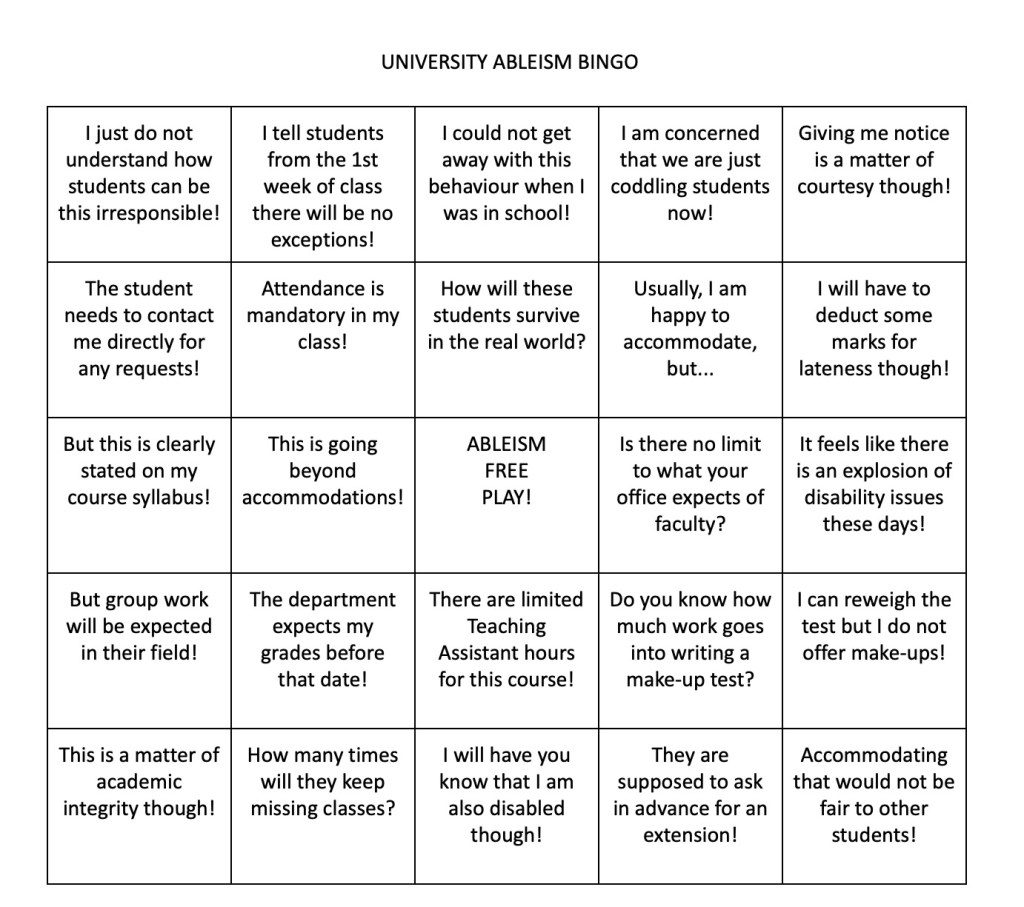
University Ableism Bingo
Krystal Jagoo
i never knew how lonely I felt until
Sri Prasad
i never knew how lonely i felt until
i met them,
shared stories with them,
felt seen by them.
i soaked in
smiles as bright as
the glow of diyas,
chai cradled in word-worn fingers,
laughter, joy, community.
i felt buoyed, light, wind-like
as dozens of hands,
cupped together, came together,
like lotus flowers.
they reached,
supple, strong, generous,
together
and lifted me towards the sun.
Lunchtime Lamentations
Sukanya
Okay, how do I do this? I stand a couple feet away from a spider in my kitchen. I shudder, noticing the dark hairs coating its gross legs.
Maybe I can skip lunch today.
“Babe, you have an eating disorder,” my friend Kavi’s voice bounces around in my head. A few weeks prior, she had draped an arm around me, saying these words.
Before I could say anything, freshly assembled nachos were placed in front of us. I had no choice but to nibble on a chip.
Back in my kitchen, the spider is resting in the corner of the counter, far enough that I could risk reaching for a banana without disturbing it, but I feel queasy now.
“A lot of women forget to take care of themselves. We’re so used to taking care of other people, that we forget to eat,” Kavi had explained.
I was too embarrassed to tell her that I’m more the type of woman who avoids caring for others because she can barely care for herself. I only consistently ate because of the women in my family – the mothers, grandmothers, and aunts. At least once in my life, each one of them has sat down and fed me by hand, knowing that I would just skip lunch otherwise.
If it’s too saucy or crumbly, it gets on my fingers and makes a mess. If it’s too dry, it gets stuck in my throat and it’s a chore to chew. The smell of cooked food makes me nauseous. I’m trying to explain that it’s not about my body. At least not all the time. If I never had to eat again, I wouldn’t. I feel like an alien trying to learn what humans do. It’s an aversion to food.
The spider hasn’t moved for some time. I scurry past it to the fridge, eyes glued to my unwanted roommate.
Inside the fridge are stacks of containers filled to the brim with eggplant curry, lentils, and spinach. My family has lovingly stocked my fridge with homemade Tamil food. The types of cultural dishes that people go out and pay money to try. These women have survived wars, immigration, and real losses. And then there’s me, defeated by the smell of tomatoes.
After two days in the fridge, one curry has a thin film of oil sitting on top. I eye it like it has personally offended me and turn to check on the spider. He’s still there.
I think about the mothers in my life, who show their love through food. Ammamma crushed rice into the palm of her hand to feed me. Periamma loaded everything she made with finely chopped vegetables. Amma always made sure I ate three meals a day.
If I won’t eat for my own sake, I’ll do it for them, today and every day ahead. Lunch in hand, I sneak another look at the spider. He watches silently, as I eat my first bite.
The Work Party
Suzanne Fernando
I am brown
it’s unmistakable
The hue of a 1000 ancestors
emblazoned in my skin
I gleam in some circumstances
in others I must shrink
Once my boss said,
“Filipinos are the lowest of the Asians”
as she took a bite of her salad
and a sip of chardonnay
my heart began to race
I felt the hairs on my arm stand on end
She laughed
and then talked about her son’s new job
I had a stomach ache
And went home
The Winter Landscape
of the Inuit people, Kangirsuk, Nunavik
Fatima Ahmed

The Past
Sumaiya Matin
Part 1:
I will not write about the past, because it cannot be changed.
Will not write about the past, because it cannot be changed.
Not write about the past, because it cannot be changed.
Write about the past, because it cannot be changed.
About the past, because it cannot be changed.
The past, because it cannot be changed.
Past, because it cannot be changed.
Because it cannot be changed.
It cannot be changed.
Cannot be changed.
Be changed.
Changed.
Part 2:
I cannot write about the past;
the past is not a draft to edit.
Part 3:
The past is an unmovable boulder, subject to erosion.
Owning your Stories Reflection
Saher Shaikh
When we women meet, we tell stories we have wrapped in thick layers of silence and put to sleep. A brooding quiet, like the steel chest my mother keeps on the sunny balcony, rarely opened, filled with blankets and extra pillows, carrying the scent of buried depths. Owning Our Stories Writing Circle was a space to air our feelings that were considered ‘extra’.
When we women meet, the extra is essential. Sometimes a writing prompt manifested as a series of lily pad thoughts in our pool, with our voices jumping from one to another. Sometimes a prompt evoked a kaleidoscope, a pattern of how we merge into and separate in our South Asian uniqueness. There is a specific thread of vulnerability and strength that ran across the tapestry of our group. A few lines I wrote speak to the heart of that vulnerability:
I make space for darkness by not naming it darkness. Space is filled with dark matter. What we don’t understand, we call it darkness. When you are made of clay, you are remolded and fill up space in varying shapes. The unnamed ridges and hollows have as much meaning as the curves and bulges of limbs. Sometimes I whistle through them and sometimes I let them be. The space called darkness has the power of transformation.
There was no judgement of what I felt in that moment; the honeyed and the putrid, the mush and the brittle. We tasted with sacredness all that we offered each other by listening intently. One time we wrote about a leaf we had picked in autumn:
Upon closer look, my leaf is a dried-up flower. From within its pockets, the petals now peek with purple resentment. To be once the focus of the eye and then to be lowered into oblivion. To be forgotten before the fall from the stem is a disgrace. We all want to die as beloved heroes. My fingers test it, like pressing the mattress in the shop. Will it hold the weight of my grief? It rustles and pushes back as if to say– leave me.
To Sheniz for creating a safe space and to all my fellow women writers for holding it open:
Love and write on. It is time for the writing circle to unfurl but the experience of awakening and sharing my stories with the women in our group reminds me of these lines of Rumi,
People are going back and forth across the doorsill
where the two worlds touch.
The door is round and open.
Don’t go back to sleep.
 Owning our Stories